
How Much Money Do You Need to Start a Charitable Trust?
Charitable Trust Viability Calculator
Enter your intended contribution amount to see which trust structure is most efficient for you.
Strategic Recommendation
Enter an amount above to receive a tailored recommendation.
You’ve got the vision. Maybe you want to fund scholarships for local students, protect a family business’s legacy, or support a specific environmental cause in your community. The idea of creating a charitable trust is exciting because it offers control and tax benefits that simple donations can’t match. But then comes the reality check: how much cash do you actually need to make this legal entity work? Is $10,000 enough? Do you need half a million? Or is there no real minimum at all?
Here’s the short answer: legally, you can start a charitable trust with almost any amount. Practically, though, there’s a "functional minimum" where the costs of running the thing stop eating up all your good intentions. If you put in too little, administrative fees will drain the pot before it ever helps a single beneficiary. This guide breaks down the real numbers, the hidden costs, and the sweet spots for different types of trusts so you don’t accidentally set up a money pit.
The Legal Minimum vs. The Practical Reality
Legally speaking, most jurisdictions don’t require a massive sum to establish a trust. In many places, including New Zealand and parts of the US, you could technically seed a trust with $100. A lawyer drafts the deed, you transfer the $100, and boom-you have a trust. But does it function as a charity? Not really.
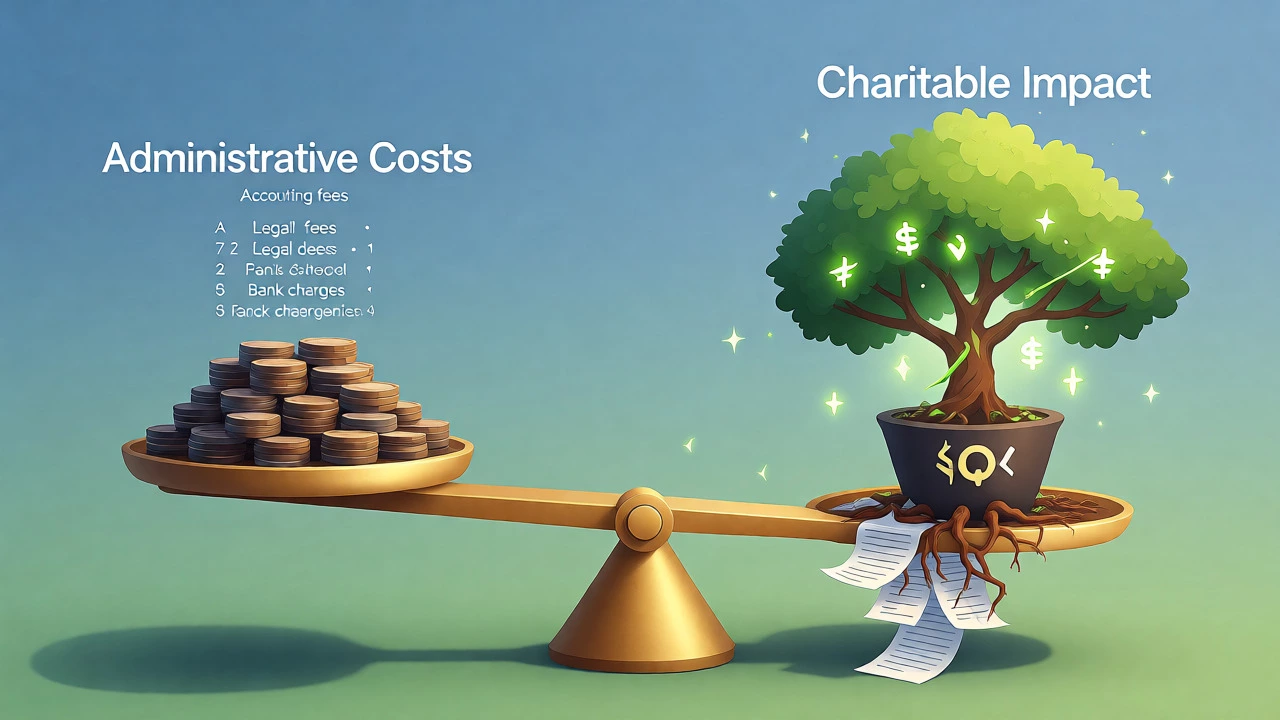
The problem isn’t the setup; it’s the upkeep. Every year, your trust needs to file taxes, potentially pay an accountant, maybe hire a trustee if you’re not managing it yourself, and cover bank fees. Let’s say those annual admin costs total $500. If your trust only holds $1,000, you just spent 50% of your capital on paperwork. That’s not efficient philanthropy; that’s burning cash.
Most financial advisors and charity experts suggest a practical floor. For a self-managed family trust where you handle the paperwork, you might get away with $10,000 to $20,000. But if you want professional management, investment diversification, and proper compliance without pulling your hair out, you’re looking at a starting point closer to $100,000 to $250,000.
| Trust Type | Minimum Recommended Capital | Annual Admin Cost Estimate | Best For |
|---|---|---|---|
| Private Family Trust (Self-Managed) | $10,000 - $25,000 | $200 - $500 | Small local grants, family legacy |
| Community Foundation Fund | $10,000 - $50,000 | ~1% of assets (covers admin) | Donors who want zero hassle |
| Independent Private Foundation | $250,000+ | $2,000 - $10,000+ | Larger endowments, complex goals |
| Donor Advised Fund (DAF) | $5,000 - $25,000 | 0.6% - 1.0% fee | Flexibility, immediate tax deduction |
Where Your Money Actually Goes
It’s crucial to understand that the money you put into a charitable trust doesn’t disappear-it works. However, it has to fight off two enemies: inflation and administrative overhead. When you calculate your initial contribution, you need to account for three distinct buckets of expenses.
First, there are the one-time setup fees. This includes legal drafting of the trust deed, registration with government bodies (like the Charities Commission in NZ or the IRS in the US), and transferring assets. Expect to pay between $1,500 and $5,000 for legal help if you use a specialized attorney. If you try to DIY this using online templates, you risk getting the wording wrong, which can lead to expensive fixes later. It’s rarely worth saving $1,000 now to lose $5,000 in tax penalties later.
Second, there’s ongoing maintenance. Even if you manage the investments yourself, you still need to produce annual reports. In New Zealand, registered charities must file annual returns. In the US, private foundations must file Form 990-PF. These filings often require a CPA or tax specialist. Budget at least $300-$800 per year for basic accounting. If your trust holds complex assets like real estate or illiquid stocks, that number climbs fast.
Third, consider the opportunity cost. If you tie up $50,000 in a trust that generates a 4% return ($2,000/year) but costs $1,500/year to run, you’re only distributing $500 to your chosen causes annually. Is that impactful? Probably not. This is why smaller amounts often work better in a Donor Advised Fund (DAF) or through a Community Foundation, where they pool your money with others to spread those fixed costs across thousands of donors.
Alternative Routes for Smaller Budgets
If you find the $100k+ threshold for a standalone independent trust daunting, don’t give up. There are smarter ways to achieve similar outcomes with less capital. The most popular alternative is the Donor Advised Fund (DAF). Think of a DAF as a charitable savings account. You contribute cash, stock, or other assets, get an immediate tax deduction, and then recommend grants to charities over time.
Why choose a DAF? Because the sponsoring organization handles all the legal, tax, and administrative heavy lifting. You pay a small annual fee-usually around 0.6% to 1% of the asset value-but you avoid the $5,000 setup cost and the headache of filing separate tax returns. Many major banks and investment firms offer these, allowing you to start with as little as $5,000. It’s perfect for people who want to bunch their donations into a high-income year but distribute them slowly.
Another option is a Field of Interest Fund within a larger Community Foundation. Here, you donate to a pooled fund dedicated to a specific topic, like "Youth Arts in Auckland." The foundation manages the investments and grant-making decisions according to your general guidelines. You don’t have individual control over every dollar given, but you get professional management and low barriers to entry. Starting thresholds here are often surprisingly low, sometimes under $10,000.
Strategic Funding: How to Structure Your Contribution
Once you decide on the vehicle, how you fund it matters just as much as how much. Cash is convenient, but it’s not always the most efficient way to build a trust. If you hold appreciated securities-stocks you bought years ago that are now worth much more-donating them directly to the trust can be a game-changer.
By donating stock instead of selling it and giving the cash, you avoid paying capital gains tax on the growth. Plus, in many jurisdictions, you can deduct the full fair market value of the stock from your income tax. So, if you have $20,000 in stock that you paid $5,000 for, donating it gives you a $20,000 deduction (subject to limits) and saves you the tax bill on the $15,000 gain. Suddenly, your effective "cost" to the trust is lower, and the trust gets a larger principal to invest.
Real estate is another powerful tool. If you own a rental property or land you don’t use, transferring it into a charitable trust can remove it from your taxable estate while generating income for the charity. However, real estate brings complexity: maintenance costs, insurance, and potential liability. Ensure your trust has enough liquid cash reserves to handle unexpected repairs on donated properties, or plan to sell the property immediately upon receipt and reinvest the proceeds.
The "Rule of Thumb" for Sustainability
A common question is: "How long will my money last?" Unlike a regular donation, a trust is often designed to exist indefinitely-an endowment. To make this work, you need to follow sustainable spending rules. Most professional trustees adhere to a 4% to 5% annual distribution rule. This means if you have a $100,000 trust, you should aim to spend about $4,000 to $5,000 per year, assuming the remaining 95% is invested to grow with inflation.
If you spend more than the return rate plus inflation, your principal shrinks. Eventually, the trust dies. If you spend less, it grows forever. For smaller trusts, flexibility is key. You might agree to spend 10% in the first few years to make a big impact locally, then taper down to 4% as the fund stabilizes. Be clear about this in your trust deed. Ambiguity leads to disputes among beneficiaries and trustees.
Also, consider the "burn rate" for temporary trusts. If you intend for the trust to dissolve after 20 years, you can spend the principal faster. In this case, a $50,000 trust could distribute $2,500 per year for 20 years, adjusted for inflation. This makes smaller sums viable for specific, time-bound projects, like building a library wing or funding a five-year scholarship program.

Common Pitfalls to Avoid
Don’t underestimate the power of vague language. I’ve seen trusts fail because the founder wrote, "I want to help poor people." What does that mean? Which city? Which age group? Without specific criteria, trustees struggle to make decisions, leading to paralysis or inconsistent giving. Define your mission narrowly enough to be actionable but broadly enough to adapt to changing times.
Another trap is ignoring liquidity. If you put 90% of your wealth into a startup equity stake or rare art, your trust might have great net worth but no cash to write checks. Always keep a healthy portion (20-30%) in liquid, income-producing assets unless your strategy specifically relies on selling assets periodically.
Finally, don’t forget about governance. Who makes the final call? If you’re the sole trustee and you pass away, who steps in? Naming successor trustees in the original deed prevents the court from appointing someone who doesn’t share your vision. This step costs nothing but saves immense heartache later.
Frequently Asked Questions
Can I start a charitable trust with less than $10,000?
Yes, but it’s generally not recommended for a standalone independent trust due to high administrative costs relative to the asset size. For amounts under $10,000, a Donor Advised Fund (DAF) or a Field of Interest Fund within a community foundation is usually a more cost-effective and flexible option.
Do I need a lawyer to set up a charitable trust?
While not strictly mandatory in all jurisdictions, it is highly advisable. Trust deeds are legal contracts with specific tax implications. Errors in drafting can lead to disqualification of tax-exempt status or costly litigation. A specialist attorney ensures compliance with local laws (such as the Charities Act in NZ or IRC Section 501(c)(3) in the US).
What are the ongoing costs of maintaining a charitable trust?
Ongoing costs typically include annual accounting/tax preparation fees ($300-$1,000+), investment management fees (if using a professional manager, ~0.5%-1%), banking fees, and potential trustee compensation. For small self-managed trusts, costs can be kept under $500/year, but this requires significant personal time and expertise.
Is a charitable trust better than a direct donation?
A trust offers greater control over how funds are used, potential tax advantages for appreciated assets, and a lasting legacy structure. Direct donations are simpler and have no admin overhead. Choose a trust if you want to influence grant-making over decades; choose direct donations for immediate, hassle-free impact.
Can I change the purpose of my charitable trust later?
Changing the core purpose (cy-près doctrine) is difficult and usually requires court approval or regulator consent if the original purpose becomes impossible or impractical. However, you can often update operational guidelines or broaden the scope slightly if the deed allows for it. Drafting flexible language initially is key.