
The Biggest Fundraisers in History: What Really Works?
Fundraising Strategy Estimator
Choose your fundraising model and input your target goals to see how the 'Success Formula' applies to your cause.
Strategy Analysis:
The Heavy Hitters: Record-Breaking Events
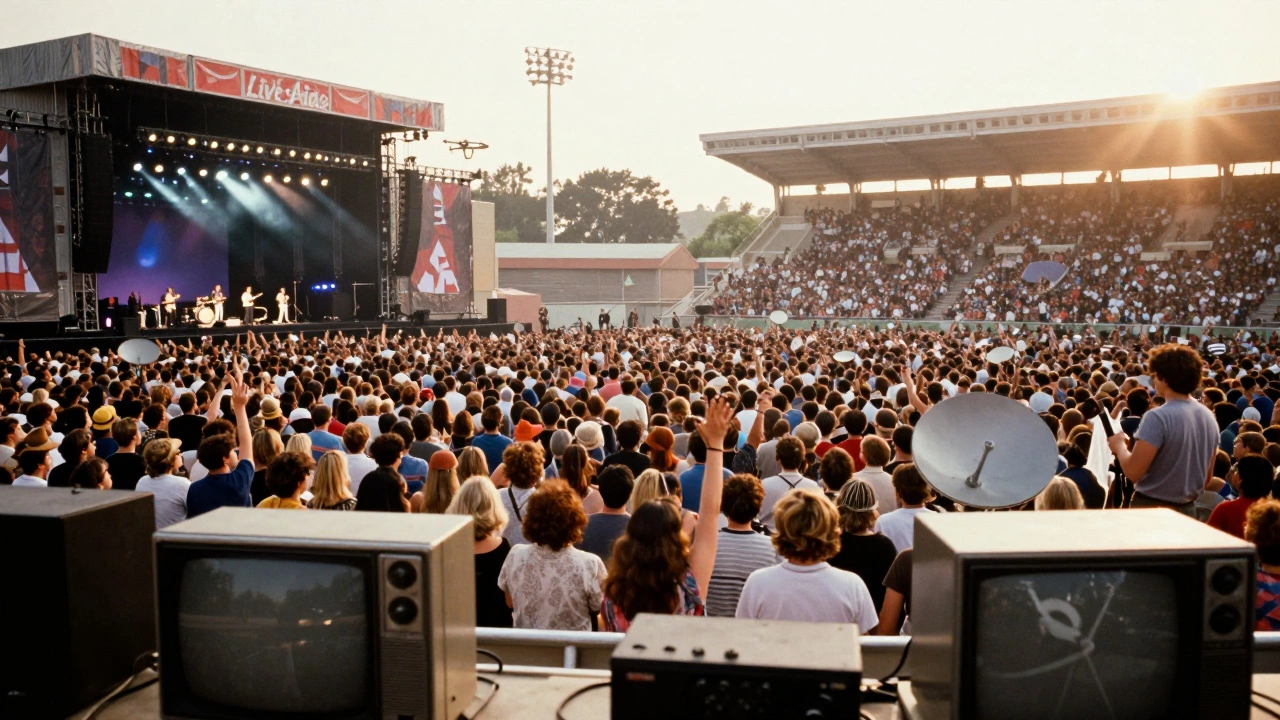
If we look at single-event spikes, Live Aid stands as a monument to the power of music and media. Organized by Bob Geldof and Midge Ure in 1985, this wasn't just a concert; it was a global phenomenon. It aimed to raise funds for the Ethiopian famine, and it did so by broadcasting a massive show across 150 countries. By the time the music stopped, they had raised roughly $127 million. In today's money, that's a staggering amount, but the real success was the awareness it created. It proved that you could leverage Mass Media to mobilize an entire planet in 24 hours. Imagine trying to do that before the internet-it was all about satellite links and landline phone calls. Then you have the modern era of Crowdfunding. Look at the 2010 Haiti earthquake. People didn't wait for a concert; they used the early versions of social sharing and text-to-donate tools. The response was an immediate flood of small donations that totaled billions across various organizations. This shifted the game from "big donors" to "millions of small donors," making the act of giving feel democratic.The Long Game: Campaign-Based Success
Single events are flashy, but if you want to see where the real money is, you have to look at systemic campaigns. The Red Cross and UNICEF operate on a scale that makes a one-off event look like a rounding error. Consider the Global Fund to Fight AIDS, Tuberculosis and Malaria. This isn't a single night of music, but a partnership that has mobilized billions of dollars since 2002. By coordinating governments and private foundations, they've managed to raise and distribute over $60 billion. This is the "most successful" in terms of sheer volume and lives saved, even if it doesn't have a single "finale" date. Why do these work? They use a model called Sustainable Giving. Instead of asking for a one-time gift, they build trust and recurring partnerships. It's the difference between a sprint and a marathon. The Global Fund succeeded because it provided a transparent framework for how money was spent, which encouraged huge grants from entities like the Bill & Melinda Gates Foundation.Comparing the Giants: Event vs. Campaign
To understand what makes a fundraiser truly "successful," we need to look at the trade-offs. A concert like Live Aid brings instant visibility, but a long-term fund like the Global Fund brings stability.| Feature | Event-Based (e.g., Live Aid) | Campaign-Based (e.g., Global Fund) |
|---|---|---|
| Speed of Funds | Instant / Explosive | Gradual / Consistent |
| Reach | Broad Public Awareness | Deep Institutional Support |
| Sustainability | Low (Ends with event) | High (Recurring donors) |
| Primary Driver | Emotional Urgency | Proven Impact/Data |

The Secret Sauce of Massive Success
What do these records have in common? It's not just luck. There's a formula here. First, there is a most successful fundraiser strategy that relies on a "Villain" and a "Hero." The villain is the crisis (famine, disease, disaster), and the hero is the donor. Second, they use Social Proof. When you see a celebrity like David Bowie or Bono asking for money, your brain subconsciously thinks, "If they care about this, I should too." This isn't just marketing; it's psychology. People are more likely to give when they see a community already in motion. Third, the call to action is incredibly specific. They don't say "Please help us save the world." They say "$5 can provide a vaccine for one child." This makes the contribution feel tangible. It turns a vague desire to do good into a concrete transaction with a measurable result. This is a core principle of Effective Altruism, where the goal is to maximize the positive impact of every single dollar spent.Modern Shifts: The Digital Revolution
Fast forward to today, and the landscape has changed. We now have things like GoFundMe and other peer-to-peer platforms. While these rarely hit the billion-dollar mark in a single go, they've decentralized fundraising. We've seen "ice bucket challenges" for ALS Association raise over $115 million in a few short weeks. This was the new version of Live Aid. Instead of a satellite feed, it was a viral video. The "event" was no longer in a stadium; it was in everyone's living room. This proves that accessibility is the new currency of success. If you remove the friction between the desire to give and the act of giving, the numbers skyrocket. However, this brings a new problem: "donor fatigue." When we are bombarded with high-stakes requests every time we open an app, the emotional urgency wears off. The most successful fundraisers of the future won't be the loudest ones, but the ones that can maintain a relationship with the donor over years, not minutes.
Pitfalls to Avoid in Large-Scale Giving
Not every big fundraiser is a success story. Some of the biggest pitfalls happen when the scale of the money exceeds the scale of the infrastructure. We've seen cases where billions were raised for disaster relief, but the money sat in accounts for years because the organizations didn't have the staff or the local knowledge to spend it effectively. This is why transparency is the ultimate metric of success. A fundraiser that raises $1 billion but only spends $100 million on the actual cause is a failure, regardless of the headline. True success is measured by the output (lives saved, trees planted), not the input (dollars raised). If you're looking at a cause to support, check for their Administrative Overhead. A healthy organization keeps its costs low enough to ensure the bulk of the money hits the ground. If the "success" is all in the marketing budget, it's not a success for the people who actually need help.Who actually holds the record for the most money raised?
If you look at single events, Live Aid is the most famous, but in terms of total volume, long-term institutional funds like The Global Fund or the Red Cross have raised tens of billions. There is no single "winner" because event-based records and campaign-based records measure different things.
Does celebrity involvement always help?
Usually, yes, because it provides a massive shortcut to attention. However, it can backfire if the celebrity's image becomes more important than the cause. The most successful celebrity-led campaigns focus on the victims and the solution, rather than the star's performance.
How has the internet changed the way we fundraise?
It has shifted the power from a few large organizations to individuals. Crowdfunding allows anyone with a compelling story to reach a global audience. It has also introduced "micro-donations," where millions of people giving small amounts can outperform a few wealthy donors.
What is the best way to ensure my donation is actually used?
Look for organizations that publish audited financial statements and have a high percentage of funds going directly to programs. Using third-party evaluators like Charity Navigator can help you see if the "successful" fundraiser is actually delivering results.
Why are some fundraisers more successful than others?
Success usually comes down to three things: a clear and urgent problem, a simple way to help, and a sense of community. When people feel that their small contribution is part of a massive, winning team, they are far more likely to give.